
Summary:–
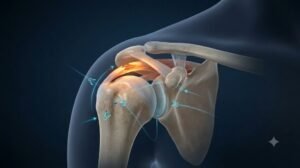
Shoulder pain can result from rotator cuff injuries, frozen shoulder, joint instability, or other conditions. Seek medical assessment if pain persists, worsens, limits movement, or causes weakness. Severe pain after an injury, shoulder deformity, sudden loss of movement, or swelling with fever requires urgent attention. An accurate clinical examination can help identify the possible cause and guide appropriate treatment options.
About Dr. Naman Wahal & Academic Leadership
Dr. Naman Wahal is an AIIMS-trained Senior Orthopaedic & Shoulder Surgeon in New Delhi. Having completed advanced fellowship training at the world-renowned ATOS Klinik in Munich, Germany, Dr. Wahal blends international surgical standards with evidence-based research.
He has authored several peer-reviewed book chapters for global medical publishers like Springer on advanced surgical techniques for shoulder instability and complex upper-limb conditions. His research contributions ensure that patients in Delhi receive state-of-the-art diagnostic and surgical care.
1. You Experience Sudden, Sharp, or Unexplained Pain
Not all kinds of shoulder pain know how to slowly and gradually develop. Out of nowhere, sharp and severe pain can hit you without any history of a fall, injury, or trauma. Even if the pain seems mild at first, you should seek clinical help immediately if it suddenly occurs or limits mobility.
The classic case of sudden pain that occurred without an injury is calcific tendinitis.
Clinical Insight: Calcific tendinitis occurs due to calcium deposits in the rotator cuff tendons. As the body tries to absorb the deposits, it creates inflammation that leads to sharp and unbearable pain making a person wake up at night
Even regular pain relief and massage will not help in case of calcific tendinitis. A skilled shoulder specialist in India can localize calcium deposits because of his experience with special tests and modern imaging tools thus ensuring the best treatment.
2. You Notice “Red Flag” Symptoms Requiring Urgent Care
While many shoulder conditions can be treated conservatively over a period of several weeks, others are medical or structural emergencies that require immediate attention. You should see a doctor right away if your shoulder pain follows a serious fall, car accident, or high-impact sports injury.
In addition, make sure to see a doctor for any of the following red flag shoulder symptoms:
Sudden weakness: Inability to lift your arm or bring it back to your side
Neurological symptoms: Shooting pain, numbness, or tingling that “shoots down” your arm, forearm, or fingers
Deformity: Your shoulder or arm appears “out of place”
Signs of infection:Warm, swollen, tender joint with fever
A prompt visit to a qualified shoulder specialist in Delhi for any of these red flag shoulder symptoms can help prevent more serious complications like permanent joint damage or infection.
3. Two Weeks of Physiotherapy Has Not Yielded Results
Physiotherapy is commonly the preferred treatment option for shoulder pain. However, physiotherapy is effective only if it is accurately applied for the right diagnosis.
If you have had prescribed physiotherapy for two weeks or more without any improvement, it is time to reassess the initial diagnosis. Continuing with the same generic shoulder exercises for several months can delay the required treatment.
A professional will assess whether the ongoing treatment is suitable for your condition. If there is no progress, getting a new evaluation by a specialist can provide new ideas for rehabilitation.
4. Reconsidering a “Frozen Shoulder” Diagnosis
Frozen shoulder (adhesive capsulitis) is among the most misdiagnosed disorders in orthopedic medicine. Usually, the doctors call stiff and painful shoulders frozen should without conducting a thorough differential physical examination. When treatments widely accepted for frozen shoulder are not effective the diagnosis must be doubted.
Real Patient Experience: The Case of the Army Serviceman
After undergoing three unsuccessful months of physiotherapy for what he thought was a frozen shoulder, the soldier came to see me. Even though he had followed the treatment faithfully, his condition did not improve.
The precise clinical examination revealed the actual problem: a torn back labrum, a torn cartilage that keeps together the shoulder socket.
This patient’s shoulder was unstable, and the treatment he followed just added to the problems
Once the diagnosis was established, the treatment plan was changed and the patient was treated successfully.
Distinguishing accurately between adhesive capsulitis and structural instability requires a profound knowledge of joint mechanics.
Dr. Naman Wahal authored book research with Springer on surgical techniques for unstable shoulders, and he uses these scientific principles in practice.
5. You are an Athlete Needing Sport-Specific Care
Sportsmen such as athletes, throwers, swimmers, and racket players can create stress and high-speed demands on their shoulder joints. Conventional clinical examinations for daily functions may not detect hidden biomechanical problems or restrictions experienced by an athlete.
For sportsmen, it is important to have the evaluation services of a sports-related shoulder expert in Delhi.
Real Patient Experience: The Cricketer with Bowling Fatigue
A competitive cricketer arrived at the clinic with ongoing shoulder pain that affected his ability to bowl accurately and with speed. Standard imaging revealed no major injuries.
However, an overhead athletic evaluation found that he suffered from GIRD (glenohumeral internal rotation deficit) that had previously gone unnoticed. His throwing shoulder had limited internal rotation as a result of repeated throws.
After designing a rehabilitation program that included stretching the tight posterior capsule tissue and strengthening the shoulder stabilizers and rotator cuff muscles, his internal rotation came back to normal. He became pain-free and went back to bowling at full ability.
Understanding Diagnostic Differences: AC Joint vs. GIRD vs. Rotator Cuff
The type of rehabilitation exercises seems to be directly correlated to proper diagnosis:
AC Joint Pain: It encompasses the tiny Acromioclavicular joint which is located at the top of the shoulder where the clavicle meets the shoulder blade. (Dr. Wahal’s published systematic study demonstrates how different AC joint injuries can be from a regular rotator cuff tear).
GIRD: This condition necessitates stretching of the posterior tissues and neuromuscular rehabilitation of the scapula.
Rotator cuff tendinopathy: It focuses on eccentric strengthening and proper load management.
Using one exercise program for different injuries is the reason why treatment fails. A good shoulder practitioner will know how to develop the right protocols for a particular body.
Diagnostic & Rehabilitation Comparison Table
| Condition | Primary Symptoms | Common Diagnostic Pitfall | Targeted Specialist Approach |
| Calcific Tendinitis | Sudden, excruciating, non-traumatic sharp pain. | Misdiagnosed as general muscle strain. | Precise imaging, anti-inflammatory protocols, or ultrasound-guided procedures. |
| Posterior Labral Tear | Deep shoulder pain, subtle instability, feeling of catching. | Frequently misdiagnosed as “Frozen Shoulder.” | Targeted physical stability tests, specialized MRI arthrogram, stability rehab. |
| GIRD (in Athletes) | Loss of throw velocity, tightness during overhead movement. | Missed on standard resting X-rays and MRIs. | Dynamic flexibility testing, posterior capsular stretches, scapular control. |
| AC Joint Strain | Localized pain on top of the shoulder when reaching across the chest. | Confused with rotator cuff tendinitis. | Specific palpation, cross-body adduction testing, localized joint therapy. |
6. You are Considering Injections or Surgery
Prior to commencing invasive treatments like steroid injections, regenerative treatments, or shoulder surgeries, it is advisable to obtain an expert second opinion. This is especially important when the advice comes from a GP or a doctor who specializes in hip or knee treatment.
The choice to go ahead with either surgery or an injection should not be based solely on X-ray or MRI results. Many structural “irregularities” observed on these tests—for example, moderate rotator cuff damage—are simply natural age-related changes that are not true causes of the patient’s pain.
A skilled shoulder specialist in Delhi will carefully evaluate the imaging results in combination with a thorough clinical physical exam, ensuring that the treatment aims straight at the actual clinical cause of pain.
Final Thoughts
Your ability to live freely and pursue your passions should not be impacted by shoulder pain. If you are experiencing acute pain, complications arise, or you see little improvement with conservative treatment approaches, the right assessment of your condition can change everything in your recovery plan. Consulting a renowned shoulder expert in Delhi is the best way to ensure that high-quality evidence-based treatment materials guide the evaluation process and plan your rehabilitation properly.
Frequently Asked Questions (FAQs)
Q1: What is the reason for my shoulder pain becoming worse while sleeping?
A: It is not unusual for individuals with rotator cuff tears, bursitis, or calcific tendinitis, to experience shoulder pain at night. This is because when you are sleeping on your back, your arm is not being pulled downward by gravity, thus eliminating the pressure on the inflamed tendons. A shoulder expert can conduct a thorough examination to find out the exact cause of the nighttime pain.
Q2: Does my shoulder pain require an MRI for diagnosis?
A: This is not necessarily true. Although MRI offers detailed images of soft tissues, seeing a doctor in person is most critical for reaching a diagnosis. The majority of the results from the MRI can actually be benign, which would not be related to the cause of your problem. It is important that the diagnosis is made based on the examination results along with the MRI.
Q3. What is the usual duration of recovery if shoulder replacement surgery is necessary?
A: After surgery, pain and discomfort diminish greatly after a period of two weeks, while any pain caused by arthritis goes away in almost no time at all. Most patients are able to resume work on their laptops about two weeks after the operation, mild movement after three to six weeks, driving about twelve weeks later, and cycling in around six months. Full recovery of strength and normal movements requires a period of three to six months.
Q4. Is it possible for a person with a torn rotator cuff to heal without surgery?
A: It is usually possible to treat partial injuries and tendinopathy (disease of tendons) effectively by means of rehabilitation, biological treatments, and lifestyle changes but patients with fully torn tendon will likely need surgery as the tendons cannot attach to the bones on their own.
Q5. What differentiates a general orthopedic surgeon from a shoulder specialist?
A: General orthopedic surgeons handle all kinds of bone and joint problems throughout the body. Meanwhile, a shoulder surgeon in Delhi has undergone a specialized fellowship training which allows him to have advanced know-how of biomechanics of the upper limb, arthroscopy as well as complex concepts like joint preservation, thus doing a much better job in terms of diagnosis and designing an appropriate recovery plan.
