

Shoulder pain rarely has one single cause, which is exactly why a shoulder specialist in Delhi doesn’t jump straight to a scan or a surgery date. Diagnosis is a step-by-step process, and understanding it helps you know what to expect at your first visit.
This guide walks through how a shoulder specialist actually diagnoses shoulder problems, what treatment options typically follow, and what recent clinical guideline updates mean for patients.
What Does a Shoulder Specialist Actually Check During Diagnosis?
A shoulder specialist starts with a detailed history – when the pain began, whether it followed an injury, and what movements make it worse – followed by a hands-on physical exam checking range of motion, strength, and specific movement patterns.
During the exam, specialists commonly use targeted tests like the Neer and Hawkins-Kennedy tests for impingement, strength testing to check for rotator cuff involvement, and an apprehension test if instability or previous dislocation is suspected. These tests, combined with your history, usually narrow down the likely diagnosis before any imaging is even ordered.
This exam-first approach matters because current clinical guidance for shoulder tendon problems specifically recommends against jumping to imaging before a proper clinical assessment, since early imaging without clear indication can lead to unnecessary tests and, occasionally, unnecessary treatment.
What Imaging Tests Are Used to Diagnose Shoulder Problems?
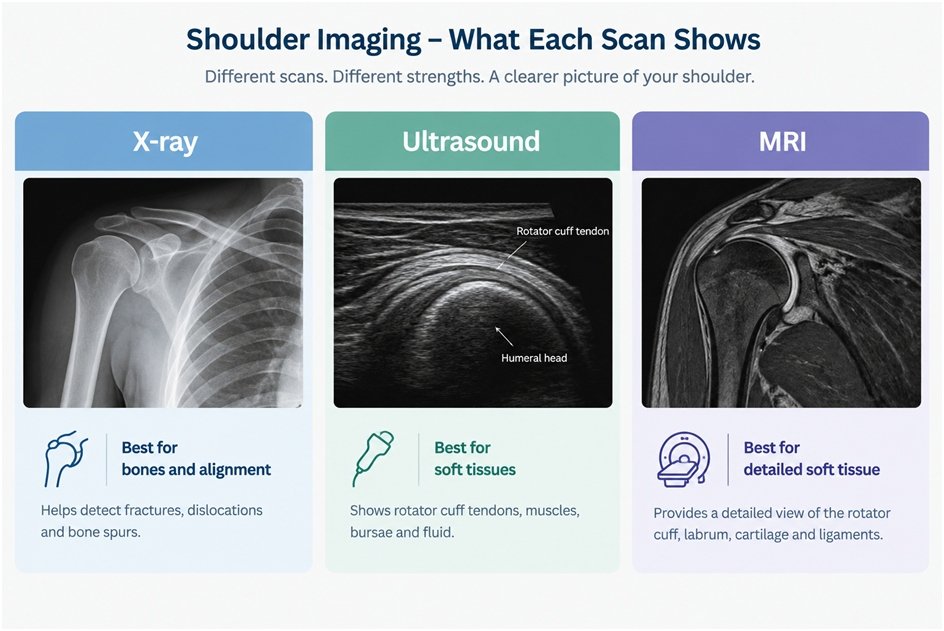
X-rays check for bone changes, arthritis, and fractures; ultrasound shows real-time movement of tendons and can detect many rotator cuff tears; and MRI gives the most detailed view of soft tissue, including the rotator cuff, labrum, and cartilage.
Each test answers a different question, so a specialist typically orders the one that matches your specific exam findings rather than requesting every available scan by default. An X-ray, for instance, won’t show a soft-tissue rotator cuff tear, while an MRI is usually unnecessary for straightforward arthritis that’s already visible on X-ray.
The American Academy of Orthopaedic Surgeons updated its clinical practice guideline for rotator cuff injuries in 2025, and one notable shift is the formal recognition of CT scans as a useful additional imaging option in specific rotator cuff cases – a reminder that imaging protocols do evolve as evidence improves, and it’s worth discussing with your specialist which test actually fits your case.
What Are the Most Common Shoulder Problems Treated by a Specialist in Delhi?
A shoulder specialist in Delhi commonly evaluates and treats rotator cuff tears, frozen shoulder (adhesive capsulitis), shoulder instability or recurrent dislocation, SLAP or labral tears, AC joint injuries, and shoulder arthritis in older patients.
Each of these conditions presents somewhat differently. Rotator cuff tears often cause weakness and pain with overhead movement, while frozen shoulder causes progressive stiffness that limits both active and passive range of motion. Instability typically follows a dislocation or repeated episodes of the shoulder feeling like it’s slipping out of place, especially during sports.
Because these conditions overlap in symptoms – most involve some combination of pain, weakness, and stiffness – a proper clinical exam is what actually separates them, which is why self-diagnosis based on symptoms alone is often unreliable.
How Are Shoulder Problems Treated? From Conservative Care to Surgery
Most shoulder conditions are treated with a step-up approach: activity modification and physiotherapy first, followed by pain management options if needed, and surgery reserved for cases where conservative treatment doesn’t resolve the problem or where structural damage clearly requires repair.
Current clinical guidance for rotator cuff-related shoulder pain places exercise-based physiotherapy at the center of treatment, with short-term use of over-the-counter pain relievers or NSAIDs where appropriate. Corticosteroid injections may offer short-term relief in select cases but aren’t recommended as a first-line treatment, and guidance suggests using ultrasound guidance when they are given, to improve accuracy.
When surgery is needed – for a significant rotator cuff tear, recurrent instability, or advanced arthritis – arthroscopic (keyhole) techniques are used wherever possible to reduce recovery time. The 2025 AAOS guideline update also highlights newer surgical adjuncts, such as bioinductive implants, that some surgeons may discuss for specific rotator cuff repair cases, though suitability depends entirely on the individual tear and patient.
What Does Recovery Look Like After Shoulder Treatment?
Recovery timelines vary significantly depending on the condition and treatment. Conservative care for mild rotator cuff issues may show improvement within several weeks of consistent physiotherapy, while surgical rotator cuff repair typically involves a structured rehabilitation period spanning several months.
Frozen shoulder recovery tends to be gradual and can take many months even with treatment, since the condition itself typically progresses through stages before resolving. Instability surgery recovery also depends on the specific procedure and how active a return to sport the patient is aiming for.
Because recovery is genuinely condition-specific, a specialist should give you a realistic timeline based on your exact diagnosis and treatment plan, rather than a generic number that applies to every shoulder problem equally.
When Should You See a Shoulder Specialist in Delhi Rather Than Wait?
Certain signs suggest it’s time to see a specialist rather than waiting it out: pain lasting more than two to three weeks, night pain that disrupts sleep, visible deformity after an injury, a shoulder that feels unstable or has slipped out of place, or progressive stiffness that’s limiting daily activities like dressing or reaching overhead.
Sudden, severe pain following a fall, sports collision, or accident should be evaluated promptly, since it could indicate a dislocation, fracture, or significant soft-tissue injury that benefits from early assessment. Waiting too long with some shoulder conditions, particularly frozen shoulder and certain rotator cuff tears, can make treatment more complicated later.
If your symptoms fall into any of these categories, an evaluation sooner rather than later generally leads to more treatment options, including a better chance of resolving the issue without surgery.
What Should You Ask a Shoulder Specialist During Your Consultation?
A productive first visit usually includes asking:
- What specific structure in my shoulder is likely causing this pain?
- Do I need imaging now, or should we start with a trial of physiotherapy?
- What does a realistic treatment timeline look like for my case?
- What happens if conservative treatment doesn’t fully resolve it?
- What activities should I avoid or modify while healing?
- How will we know if the treatment plan is actually working?
These questions help you understand not just the diagnosis, but the reasoning behind the recommended plan, which makes it easier to stay consistent with physiotherapy or post-treatment instructions.
Get an Accurate Diagnosis Before Deciding on Treatment
Shoulder problems can look similar on the surface but require very different treatment approaches, which is exactly why a proper clinical exam – not guesswork – should come before any treatment decision, surgical or otherwise.
If you’re dealing with ongoing shoulder pain, stiffness, or instability in Delhi/NCR, you can book a consultation with Dr. Naman Wahal at Fortis Escorts Hospital, Okhla, or at StepUp Joints in Lajpat Nagar, or review the full range of shoulder and joint conditions treated to see where your symptoms fit.
Frequently Asked Questions
How does a shoulder specialist diagnose the cause of shoulder pain?
Through a detailed history and a hands-on physical exam using specific movement and strength tests, followed by targeted imaging like X-ray, ultrasound, or MRI only when the exam findings call for it.
Do I need an MRI for shoulder pain?
Not always. Many shoulder conditions can be assessed clinically first, with imaging reserved for cases where the exam suggests a structural issue like a rotator cuff tear or labral injury.
What is the most common cause of shoulder pain treated by specialists in Delhi?
Rotator cuff-related problems and frozen shoulder are among the most commonly seen conditions, though the exact cause varies by age, activity level, and injury history.
Is surgery always needed for a rotator cuff tear?
No. Many rotator cuff tears, especially partial tears, are managed successfully with physiotherapy and activity modification. Surgery is generally considered when conservative treatment doesn’t improve symptoms or the tear is significant.
How long does frozen shoulder take to recover?
Frozen shoulder often resolves gradually over several months to a year, even with treatment, since it typically progresses through distinct stages before stiffness eases.
When should I see a shoulder specialist instead of waiting?
See a specialist if pain lasts more than two to three weeks, disrupts sleep, follows an injury, or comes with a feeling of instability or visible deformity – these are signs worth evaluating promptly rather than waiting out.
Dr. Naman Wahal Senior Consultant, Orthopaedics & Shoulder Surgery – Fortis Escorts Hospital, Okhla Director – StepUp Joints, Lajpat Nagar, New Delhi Book a Consultation
